SCIENTIFIC RESEARCH AND ANALYSIS WITH THE RIGHT TOOLS

The 4+1 most important scientific instruments for your laboratory

A modern chemical laboratory requires a balanced combination of basic instrumentation (glassware, balances and volumetric instruments) and advanced equipment such as centrifuges, thermostatic baths, stirrers, shakers and incubators. Only with this combination can accurate and reproducible procedures be performed, from the preparation of solutions and mixtures, to the separation and analysis of components, to the thermal control of reactions or biological cultures. In this article, we present the fundamental tools for setting up an efficient laboratory, multi-purpose for chemistry, biology, quality control, research and production.

What is a laboratory?
Strictly speaking, a laboratory is a place, room, or building, equipped for experimentation or scientific research.

What is a chemical laboratory?
A suitable place for chemical investigations, analytical investigations and for the preparation of chemicals and mixtures.

What are the tools of a chemical laboratory?
In a chemical laboratory you can find safety objects (goggles, gloves, gowns, etc.), glassware (beakers, flasks, balloons, etc.) and scientific instruments, to support the transformations carried out by the operator. This is exactly where Jointlab helps you by providing you with the ideal tools for your processes.

THE INSTRUMENTS OF THE CHEMICAL LABORATORY

1. Measuring instruments: analytical or precision electronic balances.

2. Mixing tools: magnetic and/or heating stirrers.

3. Separation tools: centrifuges.

4. Instruments for heat exchange: thermostatic baths or water bath.

+1. Stirring tools: mechanical rod agitators, vibration shakers and shakers.

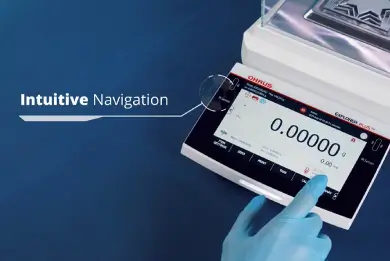
A hand with a blue glove is touching the screen of an Explorer Ohausanalytical scale.
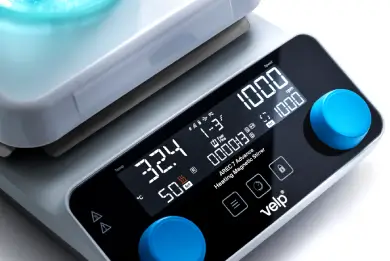
Control panel of an Advance Velp magnetic stirrer.
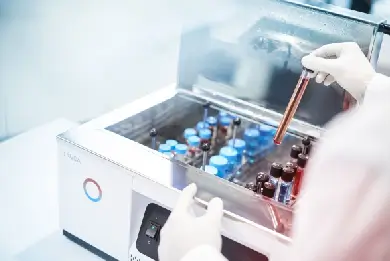
A hand with gloves is inserting a sample into a Lauda laboratory bain-marie.

Introducing the new Explorer Ohaus balances, the most advanced in Ohaus.

The digital analytical balance is one of the fundamental tools of every chemical laboratory: it allows you to measure the mass of reagents, standards, solid samples or solutions with precision down to the hundredth of a milligram. This accuracy is indispensable in the preparation of calibrated solutions, in the weighing of titration reagents, in the realization of calibration curves, in quantitative gravimetric analyses and in all processes that require reproducible results.

Since each laboratory handles samples with highly variable masses, there are models with different flow rates and resolutions. No balance can cover the entire microgram to kilogram range on its own, which is why analytical balances and technical (precision) balances are used with distinct roles. Analytical balances, equipped with a draft shield to reduce turbulence and environmental interference, typically weigh up to 200 g with a readability of 0.01 mg; Technical balances come in at approximately 2 kg with a readability of 0.01 g and are ideal for preliminary chemical preparations, weighing of non-critical solid reagents and routine checks.

The choice of the most suitable instrument depends on the laboratory protocols, the amount of reagent used in the analysis, the stability of the weighing environment, and the need for useful application functions in chemistry: density determination of solids and liquids, weight differences for batch reactions, percentage preparation of mixtures, GLP registration, traceability, and interfacing with LIMS software.

Jointlab relies on the quality of Ohaus, which has been building scales for more than a century. Its scales are among the most advanced on the market, but it provides scales of all kinds, for every occasion and budget: scales for school, university, laboratory, industry, shops etc.

One of our articles explores all the applications of scales: All the application methods of Ohaus, meaning and use.

A hand with a blue glove turns the knob of the control panel of an AREC 10 Advance Velp while waving a blue sample.

Hot plates are indispensable tools in the chemical laboratory for the controlled heating of flasks, flasks, test tubes and other vessels containing solutions, suspensions or solids. They are used when it is necessary to bring samples to temperatures at or above 100 °C, ensuring uniform and safe heating. Compared to open flame systems, such as Bunsen burners, they significantly reduce the risks associated with fire, uncontrolled evaporation or thermal decomposition.

Many models integrate a magnetic stirrer, allowing heating and mixing to be carried out simultaneously. A magnetic stir bar placed inside the glassware is rotated by a magnetic motor placed under the plate, ensuring homogeneous and adjustable mixing with great precision, even for long periods of continuous operation.
This functionality is essential in many chemical laboratory tasks: preparation of buffer solutions, dissolution of salts, organic synthesis in controlled batch, particle dispersion, catalytic activation or maintenance of reactions at a constant temperature.

The choice of the most suitable plate or stirrer depends on several criteria: required temperature range, required table size, heating power, volume of glassware used, stirring capacity, possibility of connecting temperature probes and, if desired, remote control and/or data logging software. In analytical, organic, environmental, or quality control chemistry laboratories, these factors determine the efficiency and repeatability of analyses.

Jointlab recommends the magnetic stirrers of two large companies known all over the world: the Italian manufacturer Velp and Ohaus, already known in all laboratories for their precision balances.

Velp Scientifica has just updated the whole series, and you can conveniently find the one that's right for you with the Guide to VELP Magnetic Hot Plate Stirrers.

We also recommend our article Magnetic stirrer or overhead stirrer?

Ohaus has just put the beautiful Guardian 5000 on the market, look at the features and price of the main e-G52HS07C model.

In the video below, an exhaustive explanation of how a centrifuge works.
The tool used is a Frontier 5000 FC5706 Ohaus.

A laboratory centrifuge is a fundamental tool for the separation of suspended components (liquids, cells, particles or molecules) using the principle of centrifugal force. This process makes it possible to isolate elements with different densities: for example, separate cells, sera, precipitates, DNA/RNA or cell cultures from culture liquids. During centrifugation, the denser fractions migrate to the outside of the pipe (bottom), while the less dense fractions remain closer to the central axis, allowing the selective recovery of desired components.

The available centrifuges cover a wide range to meet very different needs: from bench top micro-centrifuges for micro-volumes and molecular applications, to high-speed refrigerated centrifuges for temperature-sensitive preparations, ultracentrifuges for sub-cell fractionation and large-volume centrifuges for preparative or industrial processes.

In clinical and hospital settings , centrifuges are essential for separating serums, plasma, cellular components, preparing samples for diagnostic tests, or storing biomedical materials for later analysis. In molecular biology and biotechnology laboratories they are used for isolating nucleic acids, proteins or subcellular fractions, purification processes, extractions or for RNA/DNA preparations. In analytical chemistry, quality control and environmental research, they are used in particle separation, precipitation, sample washing, purification or pre-concentration of samples prior to spectroscopic or gravimetric analysis.

The choice of the most suitable centrifuge requires attention to several criteria: the flow rate and volume of the samples, the maximum speed and centrifugal force (RCF) required, compatibility with the type of tubes or tubes, the presence of cooling to preserve the stability of the thermolabile compounds, safety and ease of use (balancing drum, protections, etc.). preset programs).

Jointlab Consigliasi relies on Ohaus's long experience to provide you with quality products with cutting-edge performance and features. Thanks to convenient kits, it is possible to order the desired centrifuge, complete with the most used rotors.

We also have a post dedicated to the special uses of laboratory centrifuges, if you are curious take a look at Laboratory Centrifuge Use Cases.

Video dedicated to the Hydro models of LAUDA. Power on, setup and use. In particular, in the video, the Hydro 8A model.

The water bath is indispensable when it is necessary to keep samples and solutions at a constant temperature in a uniform and safe way. The thermostatic tank ensures gentle heating, avoiding peaks that could alter sensitive reagents or mixtures.

In models equipped with lids with ring openings, it is possible to adapt the opening to the diameter of the glassware, improving thermal stability, reducing evaporation and dispersion, and keeping the containers in an upright position during prolonged incubations.

In the chemical laboratory, a water bath is used to solubilize reagents, incubate samples for microbiological or biochemical analysis, maintain reactions that require constant temperature, thaw delicate materials, and homogeneously heat solutions or buffers.

The choice of model depends on the capacity, temperature range and stability, depth of tank and type of glassware used. Simple yet extremely versatile, the water bath is essential to ensure repeatability and quality in chemical laboratory processes.

Some models incorporate a stirring system that ensures uniform thermal distribution throughout the tank, which is particularly advantageous when working with samples that require precise thermal homogeneity or liquids that tend to thermally stratify.

Of the highest construction quality, Jointlab offers you the LAUDA models, the HYDRO water bath; Equipped with a digital control panel, precise and with stainless steel tank, they are suitable for all the needs of biological, medical or biochemical laboratories.

Velp's powerful OHS mechanical agitators and the possibility of remote control with the new "connect" models.

Inserting the stirring tray, accessories and setting up a digital Varioshake LAUDA .

These instruments cover all stirring and mixing needs in your chemical and biological laboratory.

Mechanical overhead stirrers are designed to handle high-viscosity samples, ensuring uniform mixing of thick liquids, suspensions, and emulsions. For faster applications on small volumes, vibrating shakers (vortex) use an effective orbital motion to mix tubes, flasks and flasks in seconds.

Multipurpose shakers, on the other hand, operate at controlled speeds with different types of movement (orbital, reciprocating, oscillating, three-dimensional or rotating) making them versatile for numerous specialized applications. They are indispensable for enzyme immunoassays (ELISA), cell and bacterial cultures, protein and DNA studies, hybridizations, staining and destaining procedures.
Their ability to maintain constant and repeatable agitation conditions makes them essential in contexts ranging from teaching laboratories to advanced research and quality control centres, where the reproducibility of results is crucial for the validity of analyses.

Velp, Ohaus and LAUDA all offer their special shakers. Velp offers overhead stirrers for every budget, from instruments with analog control to the beautiful OHS ADVANCE, Wi-Fi connected to the Velp cloud. While, for vibrating shakers we have the Velp models with unique design and the reliability of Ohaus.

NOTE

The choice of instruments for a chemical laboratory does not only concern the type, but also the construction quality, precision, safety and reliability of the manufacturer. Well-designed equipment improves reproducibility, reduces errors, optimizes procedures.

Jointlab selects only brands recognized for performance, durability and compliance with international standards, offering solutions suitable for research laboratories, chemical industries, pharmaceutical companies, production environments and quality control facilities.

Start exploring the Jointlab catalog now, or contact us to be guided in your choice.

See the author's articles
Federico Ellade Peruzzotti

In Jointlab since 2013 as a creator of texts and graphics.

Product added to compare.