High Precision 0.1mg Laboratory Analytical Balance with 320g Capacity
The OHAUS EX324 balance is the ideal solution for those seeking high analytical performance, reliability and modern functionality. With a capacity of 320 g and a readability of 0.1 mg , it ensures fast and accurate measurements even in complex scientific environments.
Main technical features:
Maximum capacity: 320 g
Readability: 0.1 mg
Typical repeatability: ±0.0001 g
Linearity: ±0.0002 g
Stabilization time: ≤3 seconds
Weighing plate: Stainless steel, Ø 90 mm
Internal calibration: AutoCal™, automatic calibration system
Display: 5.7" color touchscreen with QWERTY and numeric keypad
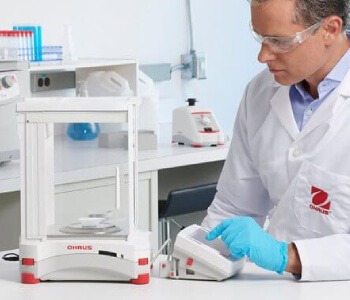
Structure: Metal base, anti-static glass screen with top and side opening
Touchless Sensors: 4 programmable sensors for contactless operations
Connectivity: USB, RS232 as standard; Ethernet optional
Units: g, mg, kg, ct, oz, ozt, lb, dwt, gn, N, momme, mesghal, tael (HK/SG/TW), tical, tola, baht, custom units
Advanced functions: Weighing, piece counting, percentage, checkweighing, dynamic weighing, formulation, totalization/statistics, peak hold, density, pipette adjustment, SQC
Ideal operating conditions: 10–30 °C, RH up to 85% (non-condensing)
Main areas of use:
Pharmaceutical laboratories
For critical weighing in formulations, batch production, quality control and drug development.
Chemistry and environmental analysis
Ideal for gravimetric analysis, determination of contaminants or residues in water, air and soil samples.
Scientific and university research
Used in academic settings for high precision experiments, preparation of standard solutions and quantitative studies.
Cosmetics industry
For the development of precise formulas and control of minimum quantities of active ingredients or pigments.
Food sector
In R&D or quality control laboratories for nutritional analysis, additive dosages and studies on microcomponents.
Metrology and calibration laboratories
For testing dosing instruments, such as micropipettes or volumetric pipettes.
Specific applications:
Formulation of samples in micrograms
Preparation of standard solutions
Quality control in regulated environments
Determination of density and specific weight
Calibration of dosing instruments
Study of reactions with differential weighing